

Most disputes between cleaning companies and their customers don’t happen during the cleaning. They happen weeks or months later — when a recurring booking gets cancelled and a refund is denied, when a deposit isn’t returned, when extra hours appear on an invoice, when scope shifts mid-contract.
Almost all of that comes back to the same root cause: the contract was light, vague or unread. This guide is for anyone in the Johor Bahru area about to sign a recurring residential or commercial cleaning agreement — eight clauses worth checking, plus five red flags worth walking away from.
Why a Written Contract Matters More Than You Think
Plenty of households in Johor Bahru book recurring cleaners on a handshake basis. It works until it doesn’t. When something goes wrong — a missed visit, a broken item, a deposit dispute, an unexpected invoice — the absence of a written agreement turns a small problem into a long argument.
A good contract isn’t there for when everything goes well. It’s there for the edge cases. Both sides know what’s included, what costs extra, who carries what risk, and how either party ends the relationship. For commercial bookings (offices, shoplots, retail), a written contract is also usually a finance-team requirement — invoices need to match a documented scope.
The good news: a cleaning service contract doesn’t need to be long. The ones that work are typically two to four pages of plain language, not twelve pages of legalese. What matters is that the right eight things are covered.
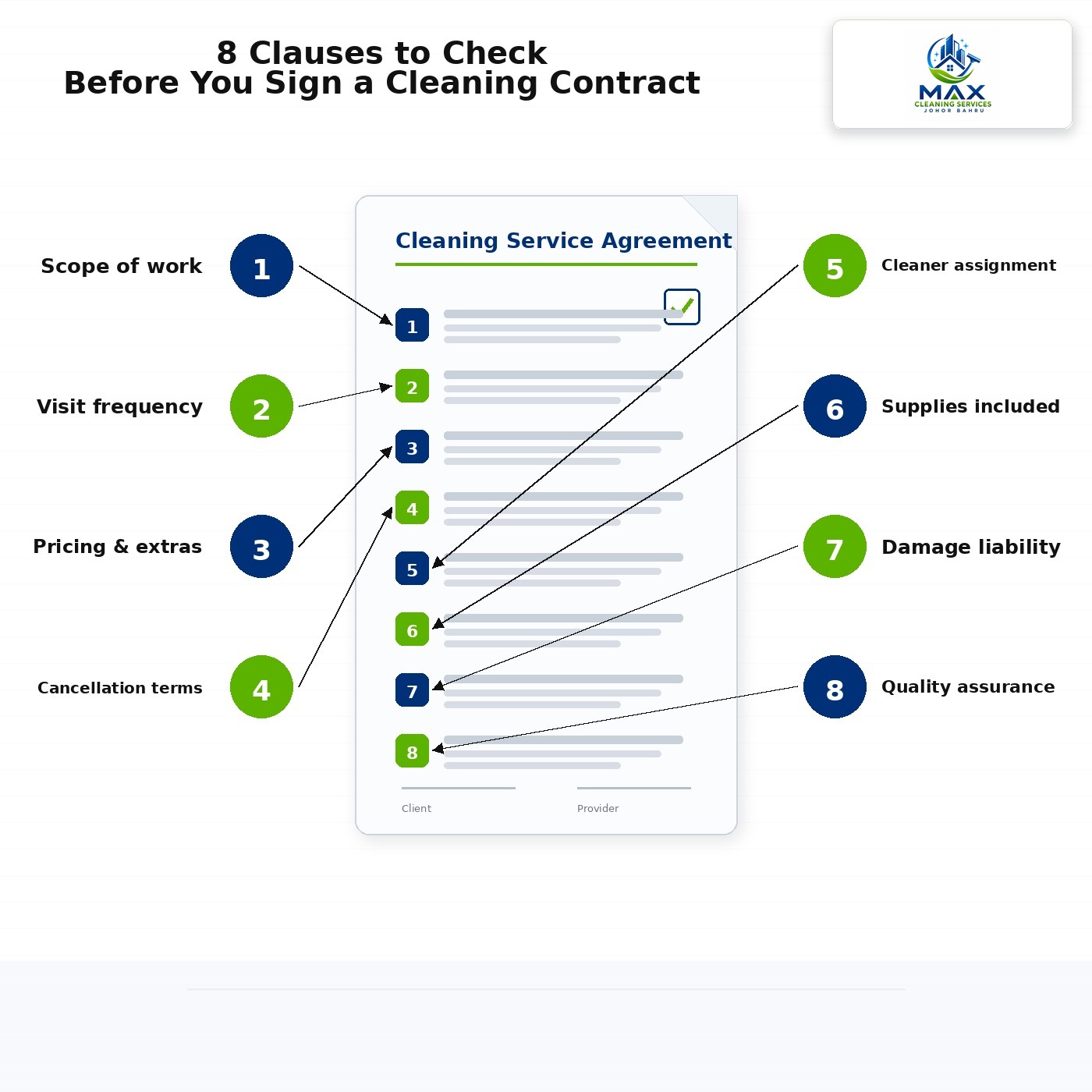
The 8 Clauses to Check Before You Sign
1. Scope of work — defined room by room or task by task
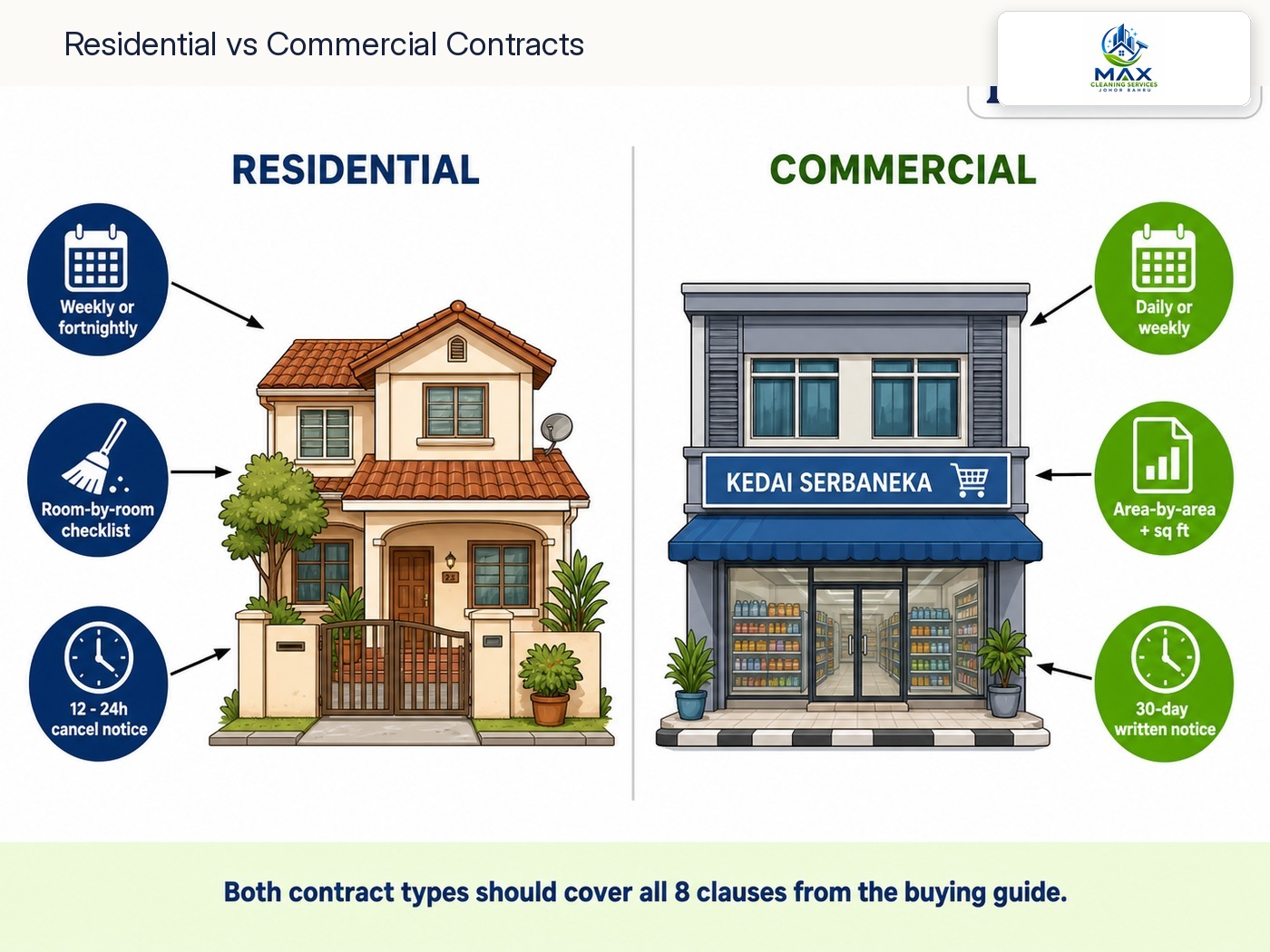
The most common cause of disputes is scope ambiguity. “Standard house clean” means different things to different cleaning companies. A solid contract lists the actual scope — by room or by task. For a residential weekly clean, that means a list like “vacuum all floors, mop tile and hardwood, clean both bathrooms (toilet, basin, shower, floor), wipe kitchen counters and stovetop, empty bins.”
For a commercial contract it means an area-by-area breakdown: workstations, meeting rooms, pantry, toilets, reception, common areas. The scope should also explicitly state what is not included — so add-ons can’t be sneaked in later as “extras.”
2. Visit frequency and duration
How often, for how long, and which days. Weekly Tuesday mornings is different from “weekly, time to be agreed.” The contract should specify both. For commercial bookings, agreed visit duration matters too — a 90-minute daily clean differs significantly from a 30-minute touch-up.
3. Pricing structure and what triggers extra charges
Two questions to answer: how is the base price set (flat per visit, hourly, monthly retainer) and what specifically triggers an additional charge. Common triggers are scope changes (adding rooms or services), schedule changes (after-hours or weekend visits), and one-off deep-clean add-ons. The contract should be specific about these — not “additional charges may apply.”
4. Cancellation, reschedule and termination terms
Three different things, often confused. Cancellation is calling off one upcoming visit. Reschedule is moving a visit to a different day. Termination is ending the contract entirely. Each should have its own notice period stated. A reasonable structure is: 24 hours’ notice for free reschedule, 12 hours for free cancellation, 30 days’ written notice for termination on a recurring agreement.
5. Cleaner assignment and substitution
If continuity matters to you — same cleaner every visit, no rotating strangers — the contract should reflect that. The clause might read “Customer will be assigned a fixed primary cleaner. Substitutions will only be made for illness, leave or training, and the customer will be notified at least 24 hours in advance where possible.” Without this language, your “regular” cleaner can be rotated month to month at the company’s discretion.
Each of our service pages spells out the standard checklist and the optional add-ons — useful reference when comparing contracts.
6. Equipment, supplies and consumables
Who provides what. Most reputable Johor Bahru cleaning companies include cleaning equipment and chemicals in the per-visit price. Consumables (toilet paper, hand soap, bin liners) for offices are sometimes included, sometimes invoiced separately at cost, sometimes supplied by the client. The contract should state which model applies — and where consumables are supplied at cost, the markup (if any) should be transparent.
7. Damage, liability and reporting procedure
What happens if a cleaner breaks something. The contract should specify the procedure: damage reported within X hours, photos taken, valuation method (replacement cost vs. depreciated value), and the company’s response time. The reporting procedure should work both ways — the customer should also have a window to report missed work without it being too late to address.
8. Quality assurance and walkthrough
How quality is maintained over time. For residential weekly cleans, this might be a monthly check-in. For commercial contracts, it’s typically a monthly site-supervisor walkthrough where standards are reviewed against the agreed scope. The contract should reference this — without it, there’s no formal mechanism to raise quality issues short of complaining or cancelling.
5 Red Flags That Should Make You Walk Away
Some warning signs are dealbreakers regardless of price. If you see any of the following in a contract, treat them as exit signals.
- “All extras to be quoted at the time.” This is a blank cheque. Any reputable cleaning company can give you indicative ranges for common add-ons (oven, fridge, deep clean, mattress steam). Vague extras language means surprise invoices.
- No cancellation policy, or one with a long notice period (over 48 hours for a single visit). Recurring household schedules change. Long notice windows lock you into visits you can’t use.
- Auto-renewal without notice. Some contracts auto-renew for another 12 months unless cancelled 60+ days before the end date. If you forget, you’re locked in. The contract should require the company to notify you of upcoming renewal at least 30 days out.
- Deposit terms that aren’t time-bound. If a deposit is required, the contract should state under what conditions it’s returned and within what timeframe. “Returned at the company’s discretion” is a red flag.
- No identified company entity or business registration. The contract should name the registered entity you’re contracting with — not just a brand name. For Malaysian companies that’s usually a Sdn Bhd or Enterprise registration number.
Our cleaners are all in-house and assigned by neighbourhood. The same team returns visit after visit.
How to Negotiate Without Losing the Relationship
Most cleaning companies in Johor Bahru will adjust contract terms if you ask. The trick is knowing which clauses are negotiable and how to ask. A few practical tips:
- Ask before signing, not after. Adjusting terms after a contract is signed is much harder than negotiating before.
- Frame requests as clarifications, not pushback. “Can we add a line that confirms inside-oven is an add-on at an agreed flat rate?” is friendlier than “I don’t trust your extras pricing.”
- Be willing to give in exchange. A longer minimum contract term in exchange for a fixed cleaner assignment is a common trade. A monthly retainer with prepayment can earn a small discount.
- Get changes in writing — even on email. A side email confirming a change to the contract is enforceable in most disputes.
A Worked Example: What a Clean Contract Looks Like
For a recurring weekly residential clean — say, a 2-bedroom condo in Tebrau — a tight contract might read:
“Weekly cleaning visit, Tuesday mornings, 9am – 11am. Two cleaners. Scope: vacuum and mop all floors, clean both bathrooms (toilet, basin, shower, floor tiles), kitchen wipe-down (counters, stovetop, sink), bedroom tidy, balcony sweep. Inside oven, inside fridge, mattress steam and sofa extraction are optional add-ons priced separately. RM X per visit, invoiced monthly. Same fixed pair of cleaners assigned after the first visit; substitutions notified 24h in advance. Reschedule with 24h notice: free. Cancel single visit with 12h notice: free. Contract may be terminated with 30 days’ written notice on either side.”
That’s the whole agreement. Nothing complicated. Both sides know exactly what they’re getting and how it ends. For commercial contracts the structure is similar but adds the floor area, the operating-hours window, the consumables model, and a monthly supervisor walkthrough clause.
Final Takeaways
A few principles to take into any cleaning contract negotiation in the Johor Bahru area:
- The contract is there for the edge cases. Read it as if everything will go wrong, and check that it tells you what happens when it does.
- Vague language is more expensive than long language. A two-page contract with specific scope beats a five-page contract with hand-waving.
- Continuity is worth a clause. If you want the same cleaner each visit, the contract should say so explicitly.
- Termination matters as much as onboarding. How you exit the contract is often the part you skim — and the part that bites later.
If you’re looking at a residential or commercial cleaning contract for the Johor Bahru area and want a second pair of eyes on the scope, our team is happy to walk through your draft over WhatsApp. We service every major neighbourhood from Mount Austin and Taman Molek through Bukit Indah, Skudai, Permas Jaya, Tebrau, Setia Tropika and beyond — see our full area coverage if you’re not sure whether your address is on our route. Or browse our full service catalogue to compare scopes side by side.